What Happens During a Neuro-Visual Evaluation?
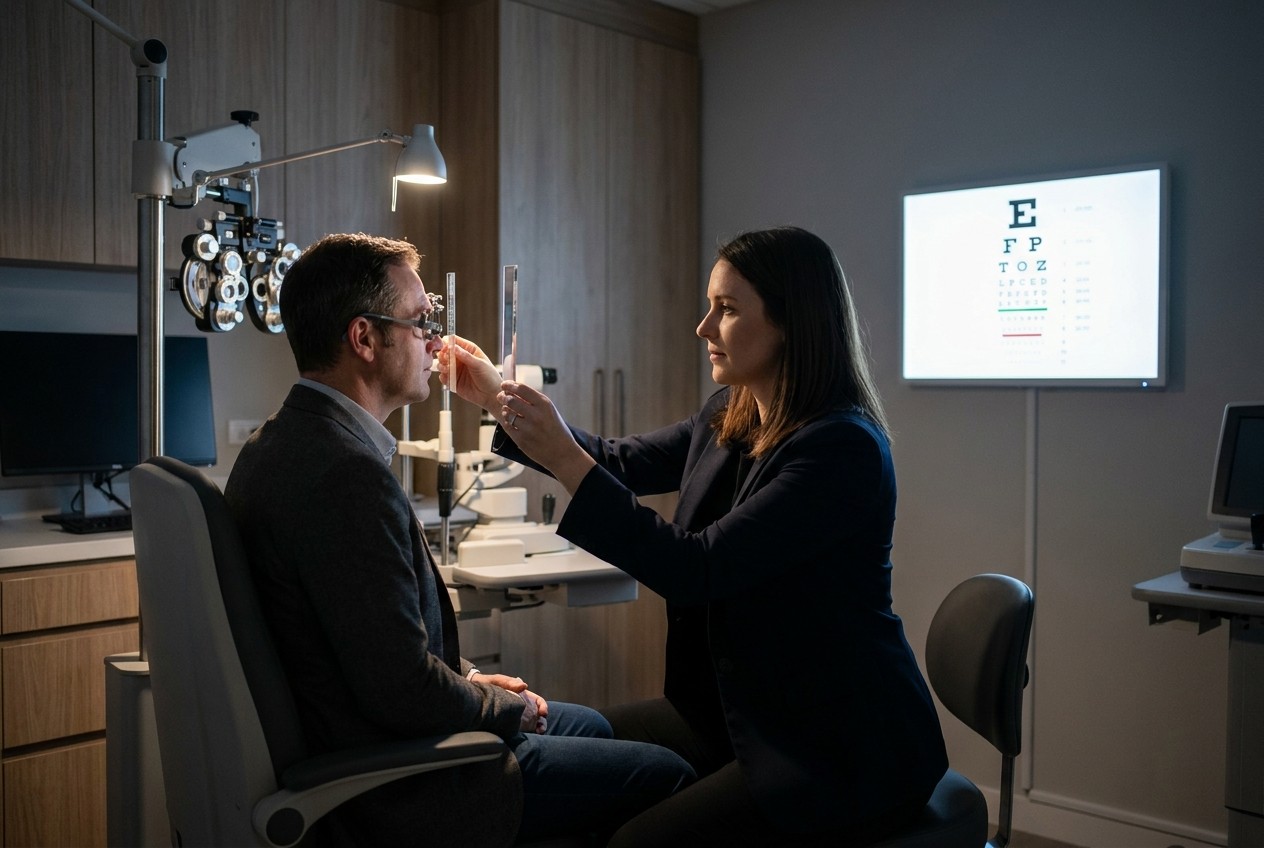
A neuro-visual evaluation goes well beyond a standard eye exam. Here's what it measures, why it matters, and who should have one.
A neuro-visual evaluation is fundamentally different from the eye exams most people have had. A routine eye exam answers one question: how clearly can you see? A neuro-visual evaluation answers a different set of questions: how well do your eyes move, coordinate, and focus under sustained use? And how well does your brain process what your eyes send?
These are the questions that matter for anyone dealing with reading difficulties, attention problems, post-concussion symptoms, chronic headaches, unexplained dizziness, or school or work struggles that a standard eye exam hasn't explained.
What a neuro-visual evaluation tests
Binocular vision: How well the two eyes work together as a team. This includes measuring the convergence near point, fusional vergence ranges, and stereopsis (depth perception). Problems here produce eye strain, intermittent double vision, and difficulty sustaining close work.
Accommodation: How quickly and accurately the focusing system responds. Accommodative dysfunction causes progressive blurring during reading sessions, along with headaches and visual fatigue.
Oculomotor function: The accuracy and efficiency of saccadic eye movements (the rapid jumps across a line of text) and smooth pursuit movements (following a moving target). Poor oculomotor control shows up as losing your place while reading and slow or inaccurate reading despite adequate word recognition.
Visual processing: How the brain interprets and acts on what the eyes see. This includes visual memory, visual-spatial skills, visual discrimination, and visual-motor integration. Processing deficits cause slow reading, poor spelling, difficulty copying accurately, and trouble with math despite normal intelligence.
Vergence facility: How quickly the eyes can shift between converged and diverged positions. Poor facility produces symptoms when switching between a textbook and the board.
How it differs from a standard eye exam
A standard eye exam takes 20 to 30 minutes and measures refractive error and eye health. A neuro-visual evaluation typically takes 2 - 3 hrs and tests the skills that reading and learning actually require. If you've had a recent normal eye exam and are still experiencing symptoms, the problem likely lives in a domain the standard exam doesn't cover.
Who should have a neuro-visual evaluation
Children who struggle in school despite normal intelligence; have reading difficulties or avoid reading; have been diagnosed with or suspected of having ADHD; or are being assessed as candidates for vision therapy. Adults who have had a concussion and are still experiencing headaches, dizziness, light sensitivity, or reading difficulty; experience eye strain or fatigue during near work; or notice visual symptoms after a motor vehicle accident or whiplash.
What happens after the evaluation
The optometrist reviews the findings directly with you, explaining what the numbers mean in practical terms and how they relate to your symptoms. If treatable conditions are identified, the optometrist outlines the options. If no functional vision problem is found, that's also useful information — it narrows the likely causes and points the investigation elsewhere.
At Toronto Vision Therapy & Optometry in North York, neuro-visual evaluations are available for children and adults. Book an appointment at tvto.ca/booking or call us at 416-498-3438.



Have questions about your child's vision?
Book a comprehensive eye exam or vision therapy consultation at our North York clinic.