Post-Concussion Vision Syndrome Explained


A normal eye exam doesn't rule out post-concussion vision syndrome. Here's the pattern of symptoms and how it's properly diagnosed.
Post-concussion vision syndrome describes a cluster of visual problems that can follow a brain injury — headaches, double vision, and light sensitivity among them. Here's what it is and how it's diagnosed.
Post-concussion vision syndrome, sometimes called post-traumatic vision syndrome, isn't a single diagnosis in the way a broken bone is a diagnosis. It's a term optometrists use to describe a recognizable pattern of visual dysfunction that shows up after a concussion or other mild traumatic brain injury — a cluster of related problems rather than one isolated issue.
The term has been used in the neuro-optometric literature for decades, but it's still unfamiliar to most family doctors and even some general optometrists, largely because it sits at the intersection of ophthalmology, optometry, and neurology rather than fitting cleanly inside any one of them. That gap between how common the syndrome is and how rarely it gets named explicitly is a big part of why so many patients spend months bouncing between providers before anyone connects their symptoms back to vision.
That distinction matters, because it explains why the syndrome is so often missed. A patient sees an optometrist, gets a clean bill of visual health on a standard exam, and is told their eyes are fine. Technically, that's often true. The eyes themselves usually aren't damaged. What's disrupted is the neural coordination between the eyes and the brain — a functional problem, not a structural one.
The cluster of symptoms
Post-concussion vision syndrome typically involves some combination of the following, though not every patient has all of them:
Blurred vision, particularly with near work or after sustained visual effort. Intermittent double vision, especially when tired. Difficulty maintaining focus on a page or screen. Headaches that concentrate around the eyes or forehead and worsen with visual tasks. Sensitivity to light, sometimes severe enough to require sunglasses indoors. Dizziness or a sense of imbalance, particularly in visually cluttered environments like grocery stores. Poor depth perception. A general feeling that visually demanding environments are exhausting in a way they weren't before the injury.
The pattern that brings most patients in is a mismatch: they were told their vision is fine, yet reading, screens, and busy spaces feel dramatically harder than before their injury.
Why it happens
Vision is not something the eyes do alone. The eyes capture light, but the brain does the actual work of converging both images into one, holding focus steady, tracking across text, and interpreting what's being seen. A concussion disrupts the neural networks responsible for that coordination, even when the eyes themselves are structurally undamaged.
Research backs up how common this is. The same Vision Research study that examined adolescents 4 to 12 weeks after a concussion found that 53% had more than one oculomotor diagnosis at once — meaning the visual disruption after concussion is rarely a single, isolated deficit. It tends to show up as several overlapping problems: an eye teaming issue alongside a focusing issue, for instance, each compounding the other's symptoms.
How it's different from a normal eye exam finding
A routine eye exam is built to catch refractive error — nearsightedness, farsightedness, astigmatism — and to check the physical health of the eye. None of that testing measures how well the eyes converge for near tasks, how quickly the focusing system responds to changing distances, or how accurately the eyes track a moving target or a line of text.
Post-concussion vision syndrome lives entirely in that untested territory. A patient can have 20/20 vision and a structurally healthy eye and still have a visual system that isn't coordinating properly under real-world demands. That's precisely what a standard exam isn't designed to catch.
Diagnosing it properly
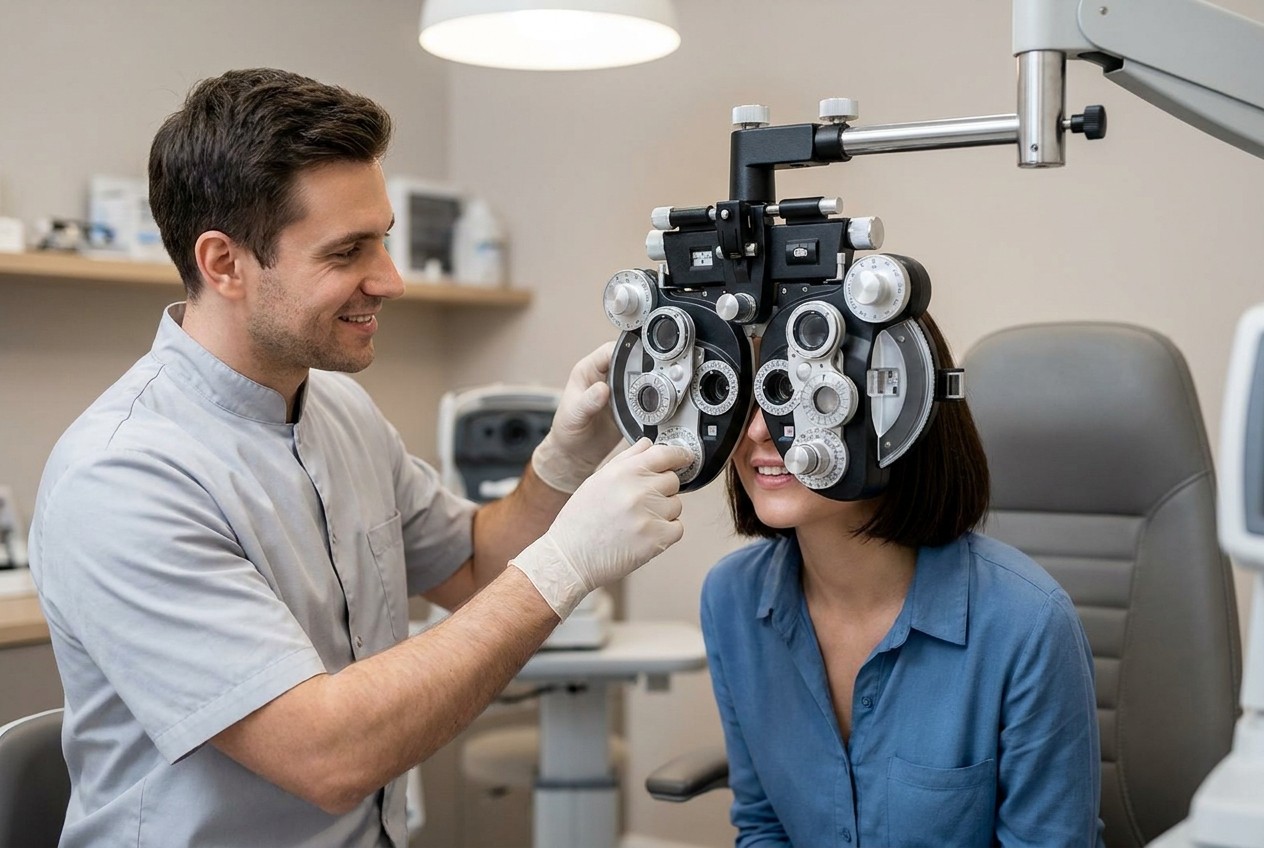
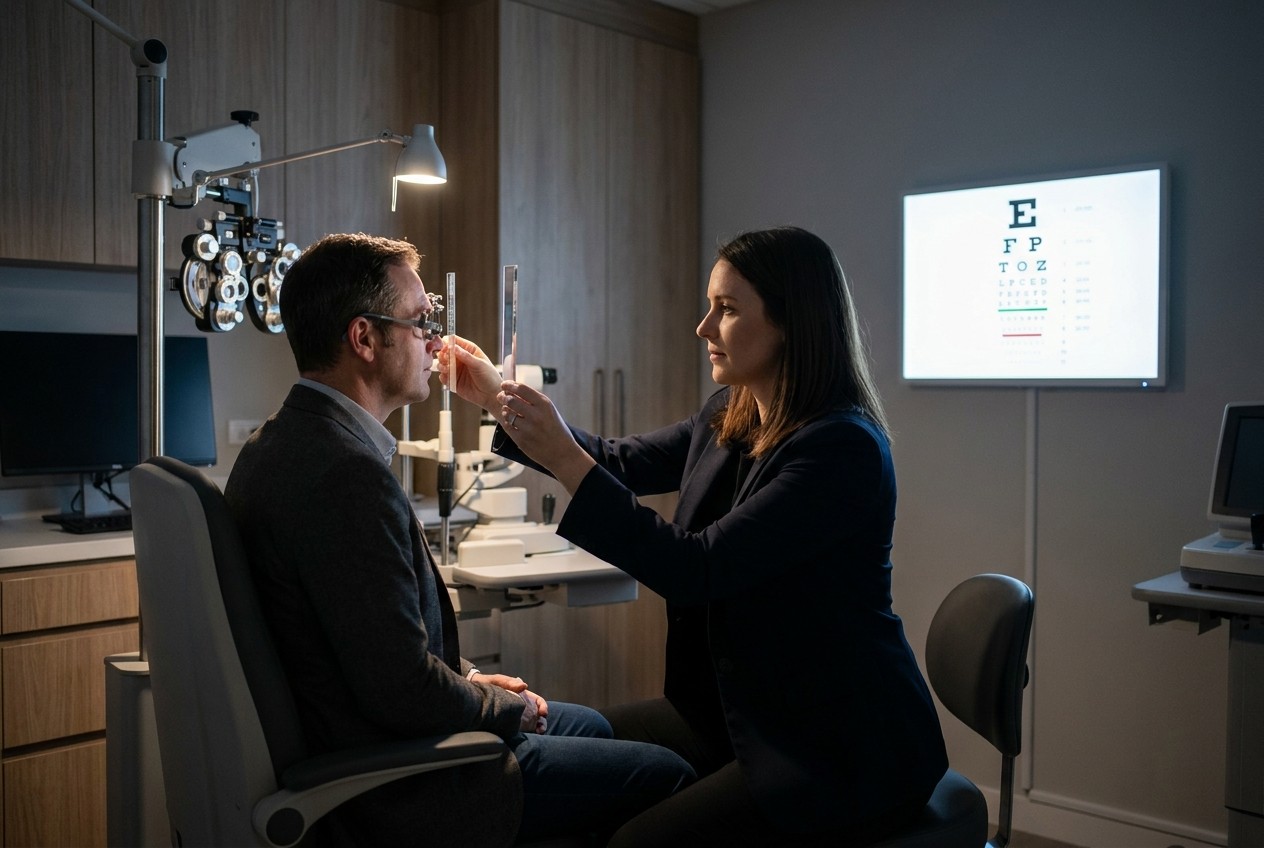
A neuro-visual evaluation, sometimes called a functional vision assessment, is the appropriate diagnostic tool. It measures convergence (how well the eyes turn inward together for near work), accommodation (how efficiently the focusing system adjusts), oculomotor control (the accuracy of eye movements), and how well the two eyes work as a coordinated team rather than independently.
This evaluation typically runs 60 to 90 minutes and is usually performed by an optometrist with training in binocular vision and neuro-optometric rehabilitation. The results give a specific, measurable picture of which visual functions are affected and to what degree — information a general eye exam simply doesn't produce.
How it's treated
Once the specific deficits are identified, treatment usually takes the form of vision therapy: a structured, progressive program of in-office sessions and home exercises designed to retrain the disrupted visual functions. This isn't passive rest and waiting. The CONCUSS randomized clinical trial, funded by the National Eye Institute, found that patients who began office-based vergence and accommodative therapy promptly after diagnosis improved significantly more than those managed with a watch-and-wait approach — 79% improved with immediate therapy compared to 13% with delayed care over the same six-week period.
Some patients also benefit from prism lenses, which can reduce strain by compensating for a coordination deficit while the underlying function is being retrained. The specific combination depends on what the assessment identifies.
What happens if it isn't addressed
Post-concussion vision syndrome doesn't reliably resolve on its own the way some concussion symptoms do. The CONCUSS randomized clinical trial, funded by the National Eye Institute, found that patients managed with a standard wait-and-see approach improved far less over six weeks than those who started structured therapy right away — a strong signal that spontaneous recovery from the visual side of concussion is the exception rather than the rule.
Left untreated, the practical effects tend to accumulate. Students fall behind because reading and screen work have become exhausting. Adults struggle with tasks that require sustained visual attention — driving, computer work, detailed paperwork — and some end up reducing hours or avoiding these tasks altogether without realizing there's a specific, treatable cause. The syndrome can also become a secondary source of anxiety and low mood, since living with unexplained, invisible symptoms that don't show up on imaging is genuinely difficult, separate from the physical discomfort itself.
None of this is inevitable. It's simply what tends to happen when the visual component of a concussion goes unrecognized for months or years rather than identified and treated early.
When to get evaluated
If it's been more than two to three weeks since a concussion and visual symptoms haven't meaningfully improved — persistent headaches with reading, light sensitivity, double vision, or a sense that busy visual environments are unusually draining — a neuro-visual evaluation is worth scheduling, regardless of what a previous eye exam showed.
At Toronto Vision Therapy & Optometry in North York, we assess for post-concussion vision syndrome specifically, using testing that goes beyond what a standard exam covers, and build treatment around what we actually find.
Frequently asked questions
Is post-concussion vision syndrome the same as having a normal eye exam?
It can look the same on paper. A patient can have 20/20 vision and a structurally healthy eye and still have post-concussion vision syndrome, because the problem is in how the eyes and brain coordinate, not in the eyes themselves.
Does post-concussion vision syndrome go away on its own?
It doesn't reliably resolve without treatment the way some concussion symptoms do. Left unaddressed, the practical effects — exhausting reading, avoided screen time, missed school or work — tend to accumulate rather than fade.
Who diagnoses post-concussion vision syndrome?
An optometrist with training in binocular vision and neuro-optometric rehabilitation, using a functional vision assessment rather than a standard eye exam. This is a different test than the one used to prescribe glasses.
Related reading
Can Vision Therapy Help After a Concussion?
Post Trauma Vision Syndrome: What It Is and How It's Treated
Can a Concussion Affect Your Vision Months Later?
Book a neuro-visual evaluation at tvto.ca/booking or call us at 416-498-3438.



Have questions about your child's vision?
Book a comprehensive eye exam or vision therapy consultation at our North York clinic.