
Convergence Insufficiency and Binocular Vision Treatment in North York
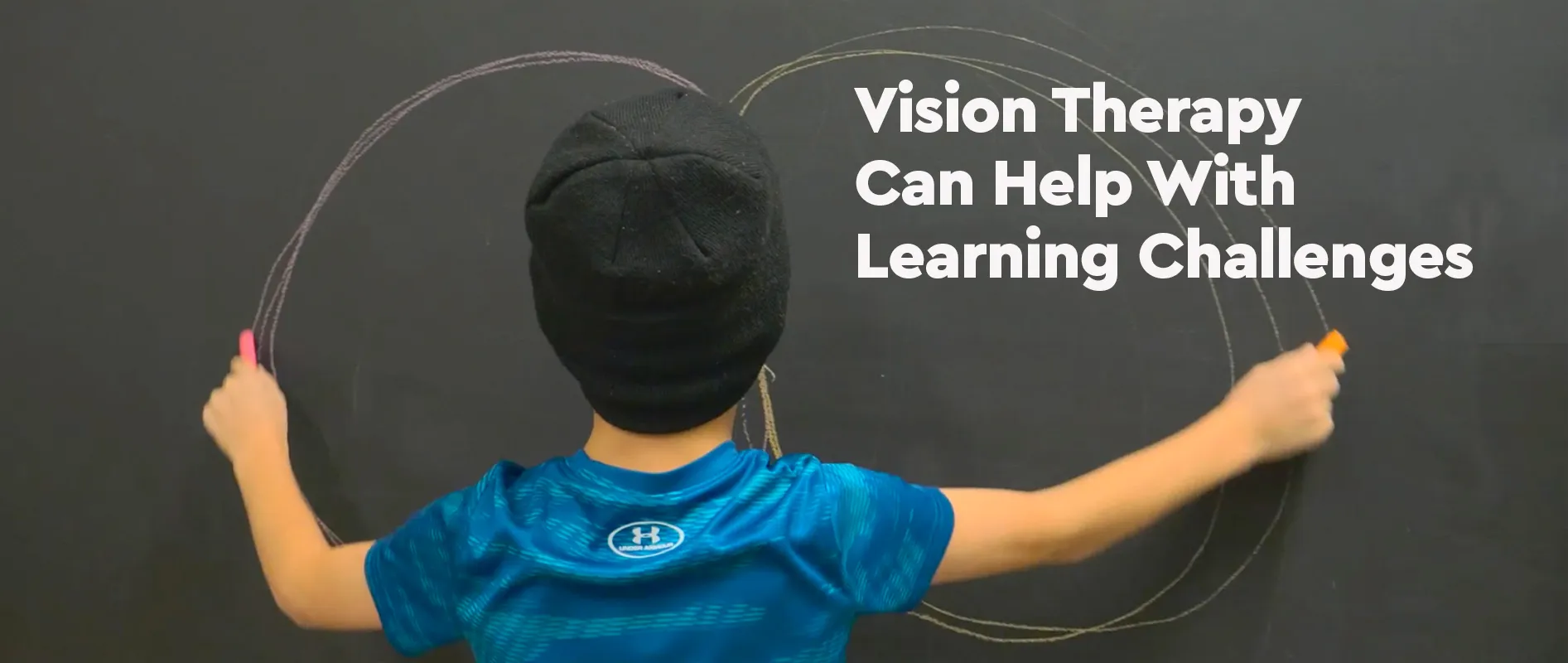
Your eyes must point at the same spot to give one clear image. When they cannot hold that position, reading, screens and busy places cause headaches, blur and double vision. A normal eye exam checks how sharp your vision is, not how well your eyes work as a team. We test eye teaming and treat the cause with office-based vision therapy.
What is convergence insufficiency?
When you look at something close, both eyes turn slightly inward. This is convergence. In convergence insufficiency (CI), the eyes cannot hold that inward turn for long. The brain then strains to join the two images, or it switches off input from one eye. The result is eye strain, headaches, words that blur or double, and tired eyes during near work.
CI is one type of binocular vision dysfunction (BVD). BVD is the name for problems where the two eyes do not work as a team. Other types include:
- Convergence excess. The eyes turn in too much, which strains near work.
- Divergence insufficiency. The eyes cannot stay aligned at distance, which can cause double vision when you look far away.
- Vertical misalignment. One eye sits slightly higher than the other.
- Intermittent exotropia. One eye drifts outward, mostly when you are tired.
Signs and symptoms
In children:
- Words blur or double after a few minutes of reading
- Headaches or tired eyes after homework
- Loses their place on the page, or skips lines
- Covers or closes one eye to read
- Avoids reading and close work
- Has trouble keeping focus on close tasks
In adults:
- Eye strain and headaches at the end of a screen day
- Double vision that comes and goes
- Dizziness, or a feeling of being off balance
- Motion sickness in cars or on escalators
- Discomfort in busy places such as supermarkets and malls
- A head tilt when you read or watch a screen
- Symptoms that began after a concussion or head injury. See neuro-optometric rehabilitation.
Why a normal eye exam and school screening miss it
A routine exam measures how sharply each eye sees a letter chart. A child can read the 20/20 line and still have CI. To find CI, the optometrist needs extra tests. These measure how close a target can come before it doubles, the point where the eyes lose and regain single vision, how much the eyes can compensate, and how the eyes align when you look at near and far targets. School screenings do not include these tests.
How we assess
Your first visit is a binocular vision assessment. It can take 60 to 90 minutes. The optometrist tests eye teaming, focusing, tracking and alignment, and checks eye health. At the end, you learn what we found, whether vision therapy is the right treatment, and what the program would look like. If you or your child needs glasses, the optometrist can prescribe them at the same visit.
How we treat it
The main treatment is office-based vision therapy. This is a personal program of supervised sessions that train the eyes to turn in and work together, with exercises to do at home between visits. Your optometrist designs the plan. Our vision therapist usually runs the weekly sessions under the optometrist's supervision. Most programs run 3 to 12 months, depending on the diagnosis. Sessions are one hour long and usually once a week.
The strongest research on CI is the Convergence Insufficiency Treatment Trial (CITT), a randomized trial funded by the U.S. National Eye Institute and published in 2008. It found that supervised office-based therapy worked better than home-based exercises.
Some patients with BVD do well with glasses that contain special prisms. The optometrist tells you if this is the better first step.
What improvement looks like
Reading takes less effort. Headaches at the end of the day come less often. Blur and double vision happen less. Children stop avoiding homework because it no longer hurts. Some children still need time to catch up on reading skills they missed while reading was hard.
Who we treat
We see patients of all ages, from young children (ages 3 and up) to seniors. No referral is needed. Family doctors, paediatricians and teachers can send patients to us, and you can also call us yourself.
Book an assessment
Call us to book a binocular vision assessment. We are on the 4th floor at Fairview Mall, 5 Fairview Mall Dr, Suite 410, North York. The TTC Don Mills station (Line 4 Sheppard) is at Fairview Mall.
Call (416) 498-3438Common questions
Will new glasses fix convergence insufficiency?
Usually not. Standard glasses correct how clearly you see. They do not change how well your two eyes work together. Some patients with BVD benefit from glasses with prisms. We test for this at the assessment.
Can adults be treated, or is it only for children?
Adults can be treated. Vision therapy works at any age. Adults often come after a concussion, or after years of headaches at a screen.
How long does treatment take?
Most programs run 3 to 12 months, depending on the diagnosis. Sessions are one hour long, usually once a week, with exercises to do at home between visits. After the assessment, our team can tell you what to expect for your case.
Is vision therapy covered by insurance?
OHIP does not cover vision therapy. Many extended health plans cover part of it under vision care or paramedical services. Ask your insurer before your visit. After your assessment, our team gives you an estimate.
My child passed the school vision screening. Could there still be a problem?
Yes. A screening checks how sharply your child sees at a distance. It does not test how well the eyes work together at reading distance.



