
Children's Eye Exams in North York OHIP-Covered and Child-Friendly
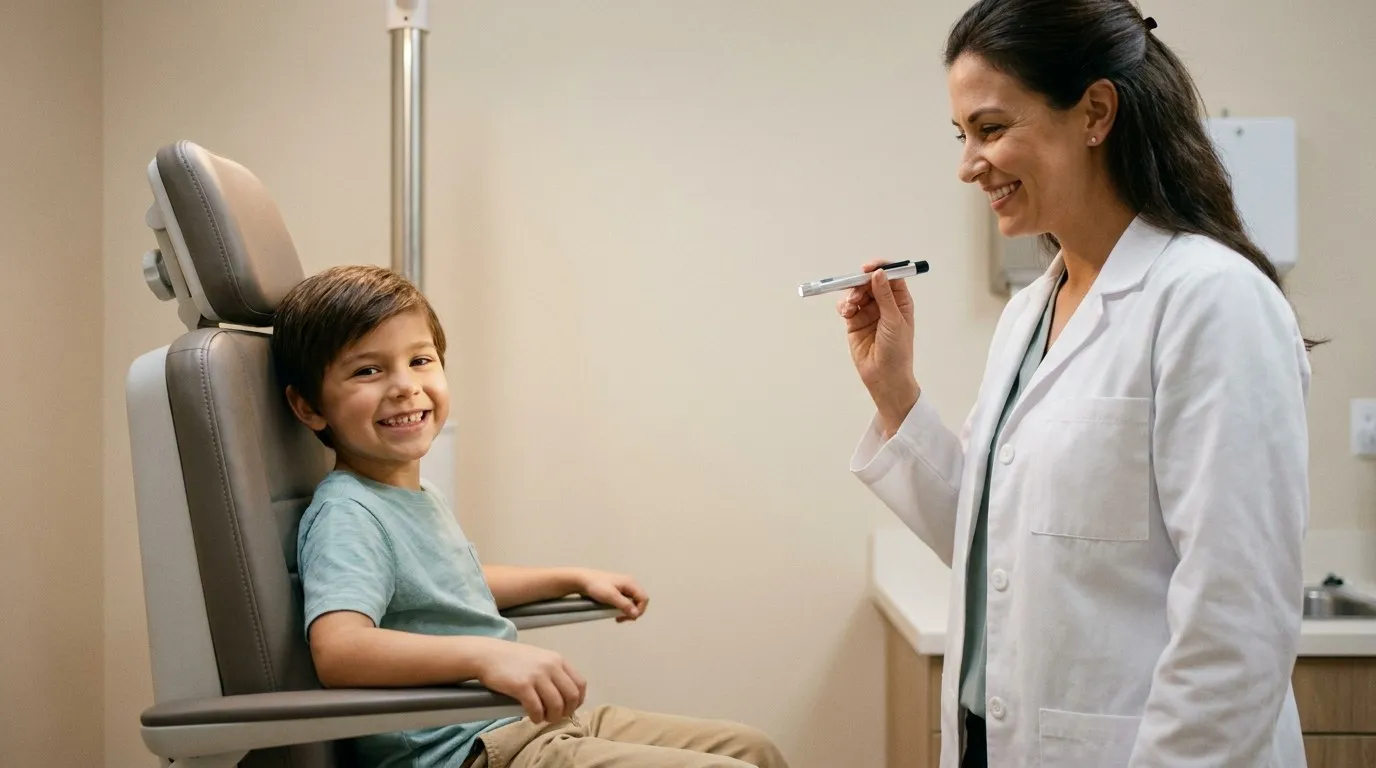
OHIP covers one comprehensive eye exam per year for patients under 20 — no cost to you.
Why children's eye exams matter
Vision problems are among the most common and most frequently missed health issues in school-age children. Kids rarely report visual difficulty. They have nothing to compare their experience to, so reading that takes twice as long as it should, or text that moves on the page, just feels like reading.
School vision screenings check distance acuity in one or both eyes. They miss most of what matters: focusing disorders, eye teaming problems, early amblyopia, and conditions like convergence insufficiency that directly affect learning. A full optometric exam is the only reliable test. Roughly one in four school-age children has a vision problem significant enough to affect their ability to learn (American Optometric Association), and most have never had a full eye exam.
What OHIP covers
Ontario covers one comprehensive eye exam per year for children and youth under 20 through OHIP, at no charge to the patient or family.
| 19 and under | One comprehensive exam per calendar year — no co-pay |
| 65 and older | One comprehensive exam per 12 or 18 months |
| 20 to 64 (no qualifying medical condition) | Not covered |
The exam itself is covered. Glasses and contact lenses are separate costs, often partially covered by extended health plans. We highly recommend adding Optomap retinal imaging, an add-on that gives our optometrists a detailed view of your child's retinal health — ask our team to include it with your visit. No referral is needed — book directly by phone or online.
When should your child have their first eye exam?
The Canadian Association of Optometrists recommends a first exam at 6 to 12 months of age, even before a child can talk. Techniques like retinoscopy and preferential looking tests assess acuity and eye alignment without requiring verbal responses. A second exam at 2 to 3 years, one at 4 to 5 before school starts, then annually from age 6 onward.
Read more: At what age should children have their first eye exam?
School screenings weren't designed to replace this schedule. They catch obvious distance acuity problems in older children. They weren't built to detect amblyopia, convergence problems, or early myopia in children who are too young to read a chart reliably.
What we check
A comprehensive exam at TVTO covers visual acuity in each eye at distance and near, refractive error (measured with retinoscopy so no verbal response is needed), eye alignment and muscle balance, binocular function and depth perception, focusing ability across distances, eye tracking, color vision, eye health, and myopia risk including family history and lifestyle factors.
Most school-age eye exams from other providers focus on the first two or three items. We cover all of them. Because we have vision therapy on-site, we approach every children's exam looking at the full picture of visual function, not just acuity.
Vision problems we screen for in children
Myopia (nearsightedness) is growing fast in children globally. Kids with myopia see clearly up close but struggle at distance. We assess myopia risk and, where the prescription is progressing, discuss control options like orthokeratology or Stellest lenses before the prescription reaches levels that raise long-term eye health risk. More on myopia control.
Amblyopia (lazy eye) is the most common cause of vision loss in children. One eye develops weaker acuity because the brain starts suppressing its input, usually with no visible sign from the outside. It needs a full binocular vision assessment to detect reliably. More on amblyopia treatment.
Strabismus is a visible or intermittent eye misalignment. One eye turns in, out, or vertically while the other fixates normally. Left untreated, it typically leads to amblyopia and affects depth perception. In school-age children, a visible eye turn also affects self-confidence.
Convergence insufficiency is probably the vision condition most often misattributed to ADHD or a learning disability. The eyes struggle to align comfortably on close-up text, so words appear to move, blur, or double. Kids avoid reading or fatigue within minutes. It responds well to vision therapy. More on convergence insufficiency treatment.
Why choose TVTO for your child's eye exam
We're a specialty optometry clinic in North York with vision therapy on-site. That means we screen every children's exam for binocular function, tracking, and focusing, not just acuity. If we find something that warrants further treatment, it's available in the same clinic without a separate referral.
We speak Mandarin and Cantonese, which matters in a community where many families are more comfortable discussing health concerns in their first language. We're at Fairview Mall, accessible by TTC.
What to bring
- Provincial health card (OHIP)
- Current glasses, if your child has them
- Notes on any concerns: headaches, squinting, reading difficulty, homework avoidance, eye rubbing
- Previous eye exam records or prescription, if transferring care
- Extended health insurance card (for glasses or any add-ons)
Sources
American Optometric Association — reading proficiency and eye exams
Frequently asked questions
Are children's eye exams free in Ontario?
Yes. OHIP covers one comprehensive exam per year for patients under 20. You don't pay for the exam. Glasses are a separate cost, often covered partially by extended health plans.
My child passed a school screening. Do they still need an eye exam?
Yes. School screenings check distance acuity. They don't test binocular vision, focusing, tracking, or early amblyopia. A child can pass a school screening and still have conditions that significantly affect their reading and learning.
How do you examine a toddler who can't read?
We use techniques that don't require verbal responses. Retinoscopy measures the prescription objectively. Preferential looking tests assess acuity in infants. Cover tests and prism assessment check for strabismus. Toddler exams take a little longer, but we're experienced with young children.
How often should my school-age child have an eye exam?
Every year. Prescriptions can change significantly in 12 months, and visual demands increase with each school grade. Annual exams are the standard recommendation, and more frequent ones if myopia is actively progressing.
Read more: How often should children get eye exams?
My child failed a school vision screening — what does that mean and what's next?
School screenings check visual acuity — how clearly your child sees — but don't test how well the eyes team, track, or focus together, so a "pass" can still miss real problems, and a "fail" doesn't always mean something serious. Either way, it's worth booking a comprehensive eye exam, which is OHIP-covered for children under 20, to get a full picture and rule out anything the screening couldn't catch.
Vision is one of the easier things to check and one of the more frequently skipped. It's covered by OHIP. There's no reason to wait.
Book Your Child's Eye Exam416-498-3438 | 5 Fairview Mall Dr, Suite 410, North York



