At What Age Should Children Have Their First Eye Exam?
Ontario's recommended eye exam schedule for children starts at 6 months — not school age. School vision screenings miss the majority of vision problems. Here's what parents need to know.
Most parents know their children should have eye exams. Fewer know when to start. The common assumption is that a child needs one when they start school, or once they complain that things look blurry. Both miss the recommended window by years.
The recommended schedule in Ontario
The Canadian Association of Optometrists and the Ontario Association of Optometrists recommend the following eye exam schedule:
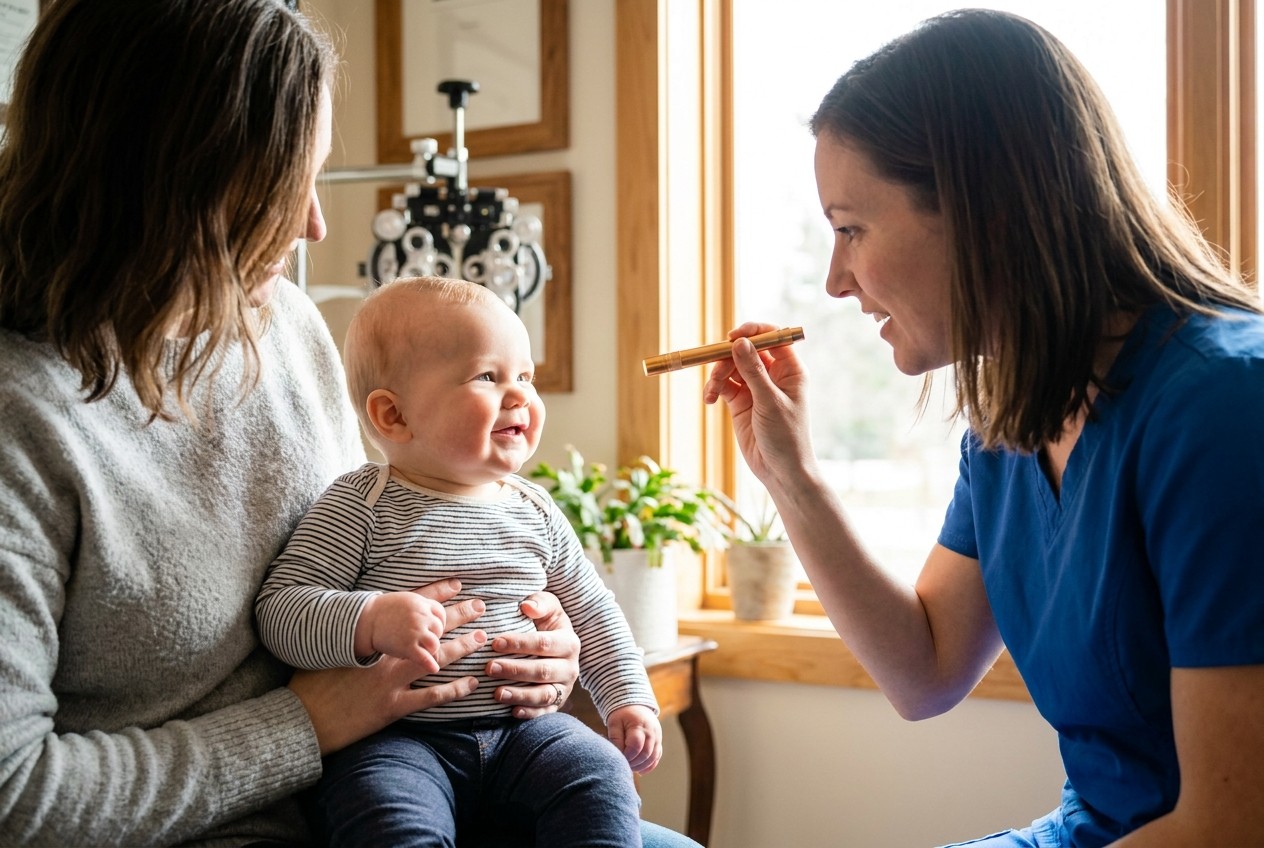
6 months: The first eye exam should happen at six months of age. An optometrist checks that the eyes are developing normally, that both eyes are tracking together, and that there's no early sign of amblyopia (lazy eye) or strabismus (eye turn). Both conditions respond far better to treatment when caught early.
Age 2 to 3: A second exam before preschool. Many vision problems that affect learning can be identified and addressed before a child ever sets foot in a classroom..
Ages 4 to 19: Annually once in school. In Ontario, OHIP covers one comprehensive eye exam per year for everyone under 20, so cost is not a barrier.
Why school vision screenings aren't enough
School screenings test one thing: whether a child can read a letter on a standard chart at a standard distance. They're reasonably good at catching significant nearsightedness. They are not designed to catch farsightedness, astigmatism, amblyopia, or any functional vision problem. A study published in Optometry and Vision Science found that school screenings miss approximately 75% of the vision problems a comprehensive eye exam would catch.
What happens at a pediatric eye exam
For infants and toddlers, the optometrist uses objective tools — retinoscopy, dilating eye drops, and visual fixation tests — that don't require the child to name letters or follow directions. An eye exam at age 3 is more practical than most parents assume. For school-age children, the exam includes acuity testing plus binocular vision assessment, eye teaming tests, and tracking evaluations.
Signs to watch for between exams
Book an early appointment if you notice squinting at the board, covering or closing one eye, holding books unusually close, sitting too close to the TV, frequent headaches after school, or a sudden drop in school performance. One sign that warrants prompt attention: a white reflection in one pupil in a photo, which occasionally indicates a retinal condition.
Toronto Vision Therapy & Optometry in North York sees children from 6 months of age. Book an appointment at tvto.ca/booking or call us at 416-498-3438.


Have questions about your child's vision?
Book a comprehensive eye exam or vision therapy consultation at our North York clinic.