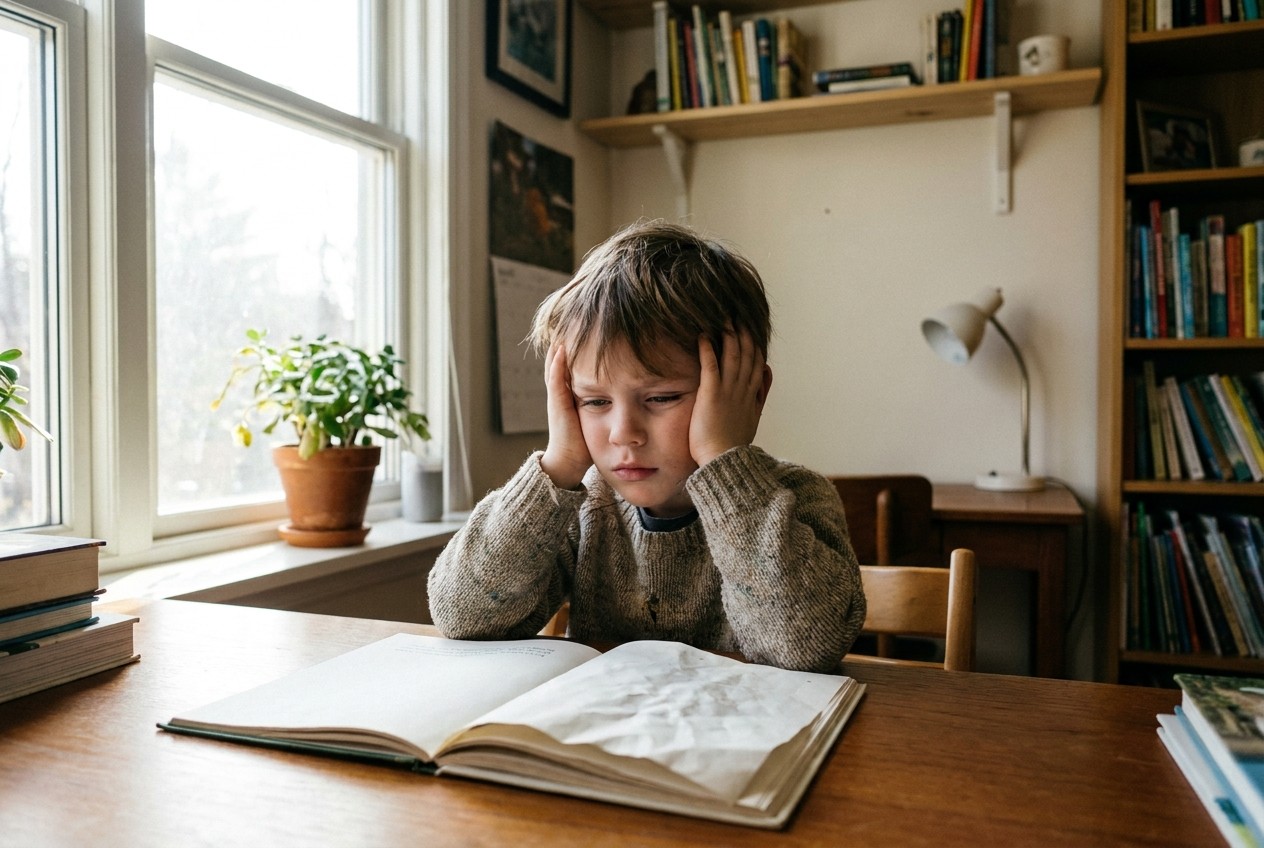
Does your child skip lines while reading, complain of headaches, or struggle at school despite being clearly smart? These 15 signs may point to a vision problem that glasses won't fix.
Many children who struggle in school have already passed a vision screening. Their optometrist said they have 20/20 vision. Their parents can't figure out what's wrong.
The problem is that standard screenings only test one thing: whether a child can read a letter on a chart from a set distance. They don't test how the two eyes work together, how the eyes move across a page, or how the brain processes what the eyes send. A child can read the bottom line of the chart perfectly and still have significant vision problems that make reading, writing, and learning harder than it needs to be.
Vision therapy addresses those functional and developmental vision problems — the ones standard eye exams don't catch. Here are 15 signs your child may need it.
The eyes need to move in small, precise jumps across a line of text and then return accurately to the start of the next line. When that tracking system is off, children lose their place, skip lines, or re-read the same sentence without realizing it.
Using a finger to track text isn't always a phase children grow out of. It's often a compensating strategy for poor eye tracking or difficulty maintaining focus on a moving target.
Words like "the," "and," and "a" disappear when a child is working hard just to hold the text stable. The brain drops the low-value content to manage the visual load.
Children don't usually say "reading gives me double vision." They say they hate reading, that it's boring, that their eyes are tired. Avoidance is a signal worth paying attention to.
Headaches at the end of a school day, especially around the forehead or temples, are one of the clearest signs that the visual system is working too hard. The muscles controlling eye coordination and focus don't get tired from reading a single clear chart — they get tired from hours of sustained near work.
When the two eyes don't team properly, the brain sometimes suppresses input from one eye to avoid seeing double. Covering an eye is the child's own attempt to fix the problem.
Head tilting is another compensating strategy, often seen when there's a misalignment in how the two eyes perceive depth or direction.
Double vision is sometimes obvious — a child will say "there are two of you." More often it's intermittent, and the child doesn't know it's abnormal because they have nothing to compare it to.
Letter reversals (b/d, p/q) are normal in early childhood. After age 7, persistent reversals more often reflect a visual processing issue than developmental lag.
A child who reads aloud accurately but can't retell what they just read is spending most of their mental energy keeping the text stable. There's little left for understanding.
If a child can focus for an hour on a video game but falls apart after ten minutes of reading, the problem is likely visual rather than attentional. Visual tasks are the specific trigger.
Handwriting requires the eyes to guide the hand accurately. When visual feedback is unreliable, the output shows it.
Eye tracking matters in sports, not just reading. Children who consistently miss catchable balls may have difficulty predicting where a moving object will be.
The visual system contributes to balance and spatial orientation. When the eyes send conflicting signals, the result can be dizziness or nausea, especially in cars, during reading, or in visually busy environments.
This is what parents describe most often. The child is obviously intelligent — curious, verbal, strong in subjects that don't require sustained reading — but reading and writing drag their marks down. That gap between apparent ability and academic output is worth investigating.
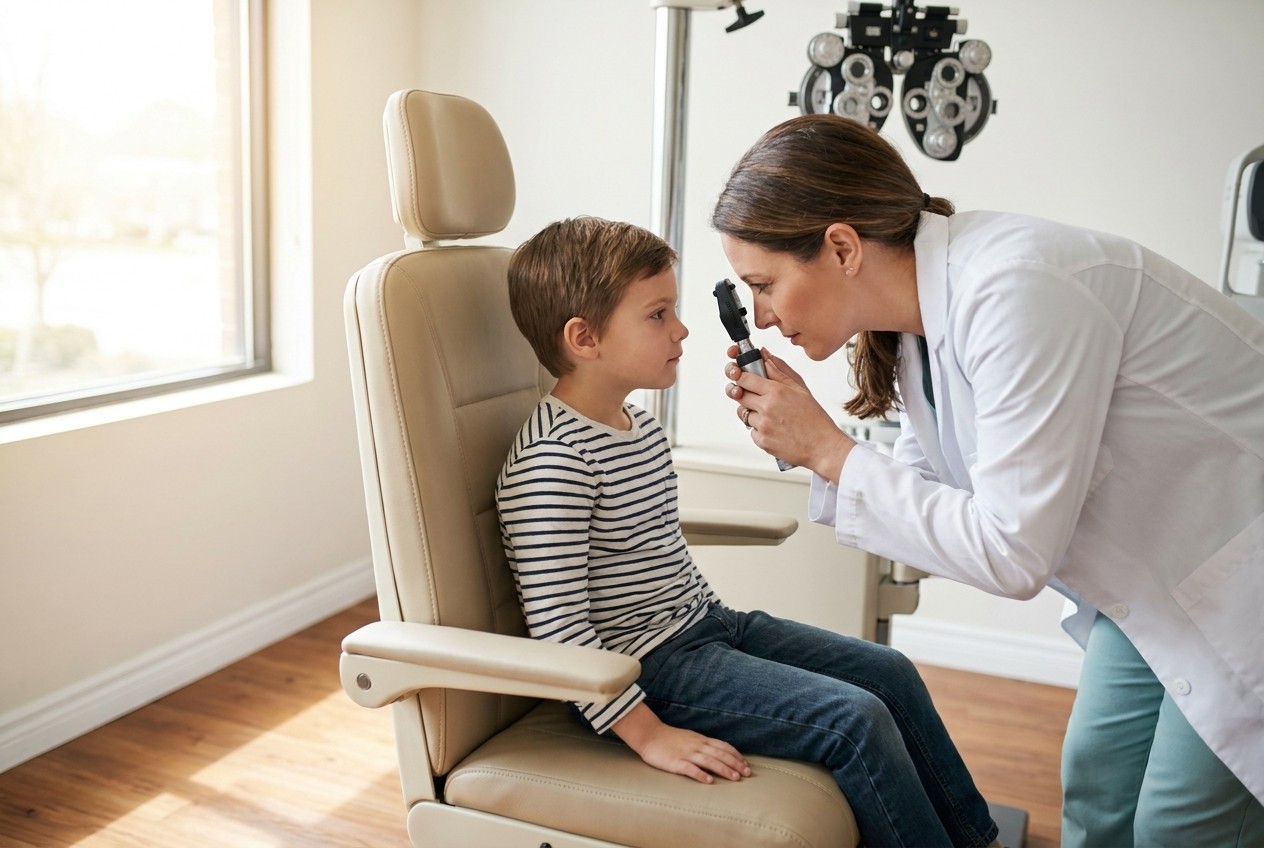
A routine eye exam checks acuity: how clearly the eye sees at a fixed distance. It won't assess convergence (how the eyes turn inward for near work), accommodation (how the eyes shift focus), saccadic eye movements (how the eyes track across a line of text), or visual processing (how the brain interprets what the eyes see).
These are the skills that determine whether a child can read a page, copy from the board, or sustain attention through a school day. And they're not tested in a standard 20-minute exam.
If you recognize several of these signs in your child, a functional vision assessment is the right starting point. At Toronto Vision Therapy & Optometry in North York, we assess the full range of visual skills — not just clarity — and develop a personalized vision therapy program if one is needed.
Book an appointment at tvto.ca/booking or call us at 416-498-3438.



Book a comprehensive eye exam or vision therapy consultation at our North York clinic.